Massage gun speed levels typically range from 3 to 30 settings, measuring between 1,200 and 4,800 RPM (rotations per minute). Always start on a lower setting and avoid using a massage gun directly over bones.
Choose low speed (1,200–1,800 RPM) for warm-ups and delicate muscles, medium speed (1,800–2,400 RPM) for post-workout recovery, and high speed (2,700–3,200+ RPM) for deep tissue work on large muscle groups.
This guide explains what massage gun speed levels mean, when to use each RPM range, and how speed works alongside stall force and amplitude to deliver an effective massage.
By the end, you’ll know exactly which speed setting is best for your warm-up, recovery, or muscle relief goals.
Quick Answer
Massage gun speed levels indicate how many times the massage head strikes your muscles each minute, measured in RPM (rotations per minute) or PPM (percussions per minute). The right speed depends on your recovery goal, not simply the highest setting.
- Low speed (1,200–1,800 RPM): Best for warm-ups, muscle activation, beginners, and sensitive areas.
- Medium speed (1,800–2,400 RPM): Ideal for everyday muscle recovery and post-workout soreness.
- High speed (2,700–3,200+ RPM): Suitable for deep tissue work, stubborn knots, and large muscle groups.
Remember: Faster isn’t always better. Choosing the right speed helps you get the most effective and comfortable massage.
- Quick Answer
- What Do Massage Gun Speed Levels Mean?
- Does a Higher Speed Mean a Deeper Massage?
- Massage Gun Speed Levels Explained
- Which Massage Gun Speed Should You Use?
- Common Mistakes When Choosing Massage Gun Speed
- Tips for Using Massage Gun Speed Safely
- Choose the Right Massage Gun Speed for Better Recovery
- Related Questions
What Do Massage Gun Speed Levels Mean?
Massage gun speed levels describe how fast the massage head moves, measured in RPM (rotations per minute) or PPM (percussions per minute).
These terms are often used interchangeably and indicate how many times the massage head strikes your muscles in one minute. In general, lower speeds provide gentler muscle stimulation, while higher speeds deliver faster, more intense percussions.
Most massage guns offer 3 to 30 speed settings, but the exact number and maximum RPM vary between brands.
Here’s what you need to know:
- RPM and PPM: Both measure how many times the massage head strikes your muscles each minute.
- Higher RPM: Provides faster muscle stimulation, making it suitable for deep tissue work and larger muscle groups.
- Lower RPM: Offers a gentler massage that’s ideal for warm-ups, beginners, and sensitive areas.
- More speed settings don’t always mean better performance: A massage gun with 30 speed levels isn’t automatically better than one with 5 or 10 well-tuned settings.
- Speed is only one part of performance: Stall force and amplitude also affect how powerful and effective the massage feels.
Although some massage guns have 30 speed settings, more options don’t automatically mean better performance.
It’s worth comparing the overall specifications, including speed, stall force, and amplitude, as explained in our Hydragun vs Theragun comparison.
Does a Higher Speed Mean a Deeper Massage?
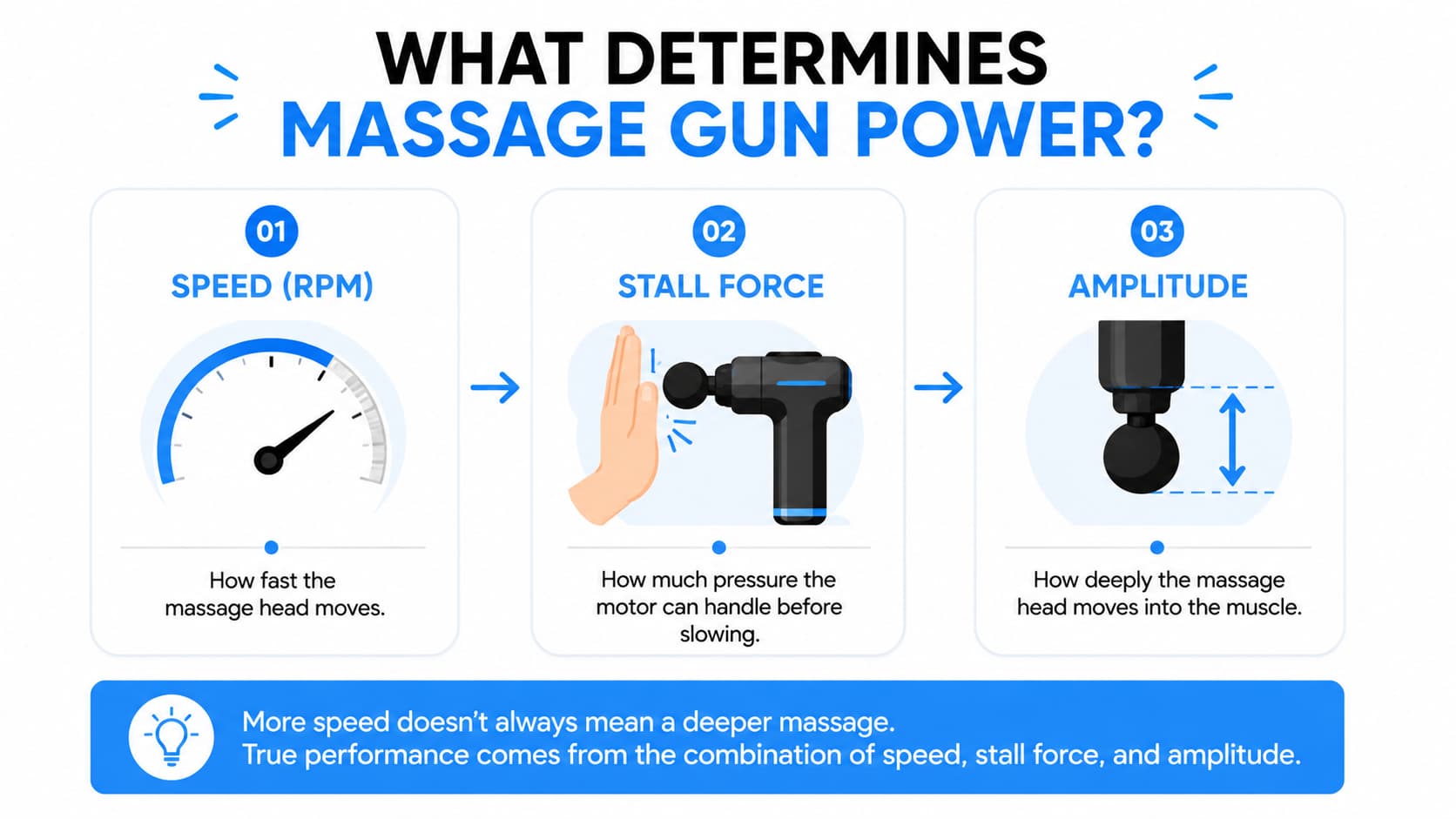
No. One of the biggest misconceptions is that a higher massage gun speed automatically delivers a deeper massage. In reality, speed and depth are not the same thing.
Speed controls how quickly the massage head strikes your muscles, while other features determine how much pressure and depth the massage can provide.
Here’s how each specification works:
- Speed (RPM): Determines how fast the massage head percusses your muscles.
- Stall force: Determines how much pressure the motor can handle before slowing or stopping.
- Amplitude: Determines how deeply the massage head moves into the muscle.
For example, a massage gun with:
- High RPM
- Low stall force
- Short amplitude
may feel less effective than one with:
- Lower RPM
- Higher stall force
- Longer amplitude
That’s why it’s important to look at the full specifications instead of focusing on speed alone. You can learn more from our article about why massage gun stall force matters and how it affects overall performance.
Massage Gun Speed Levels Explained
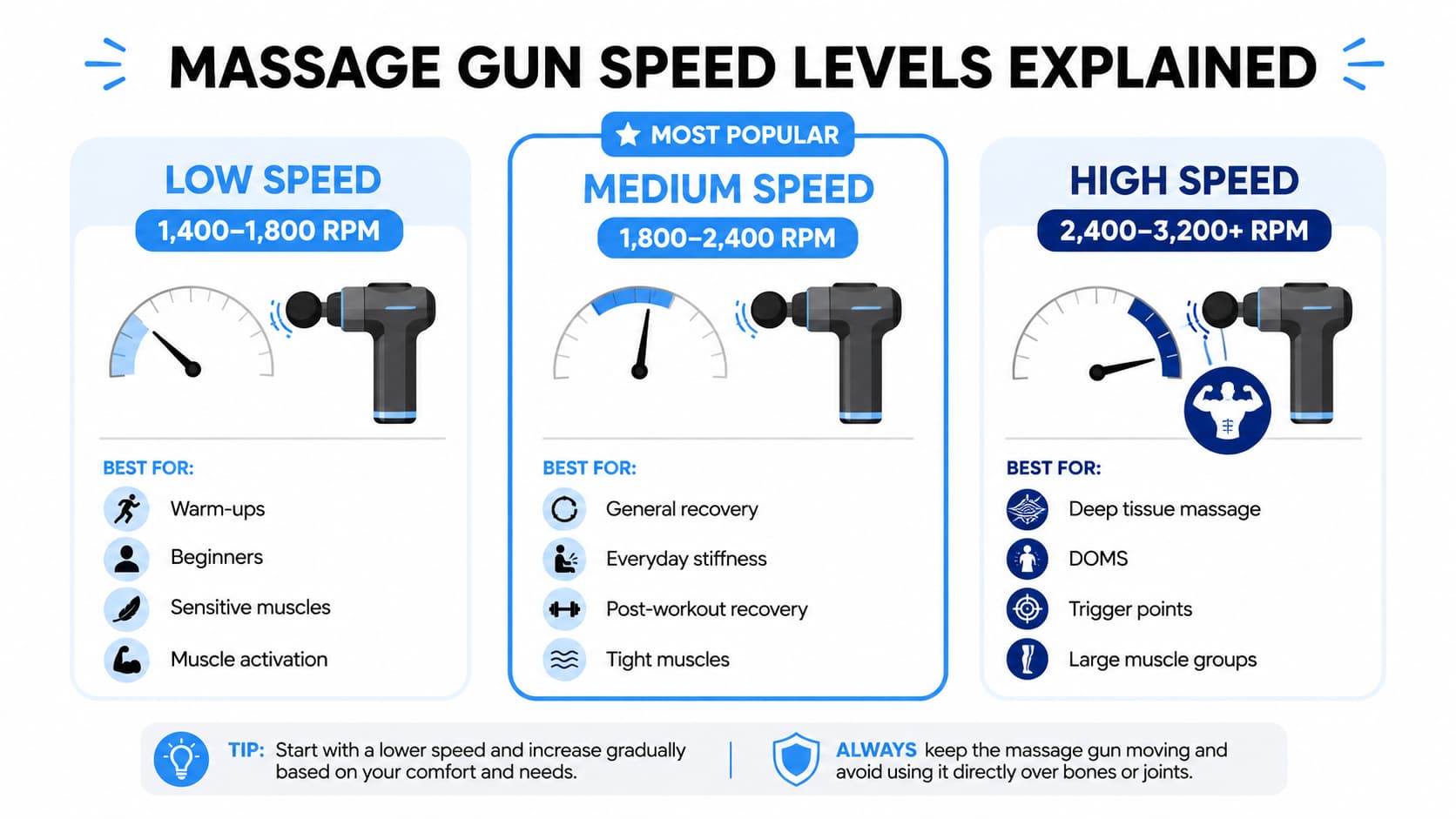
Choosing the right massage gun speed depends on what you want to achieve. Whether you’re warming up before a workout or easing sore muscles afterward, each RPM range has a different purpose.
1. Low Speed (1,400–1,800 RPM)
Low speeds provide a gentle massage that’s perfect for beginners and sensitive muscles. This level may also be a better choice if your skin is sensitive or you’ve noticed itching after using a massage gun, as higher speeds can sometimes overstimulate the skin and nerves.
Best for:
- Beginners
- Warm-ups
- Muscle activation
- Increased circulation
- Sensitive areas like the neck, shoulders, and arms
How to use:
- Move the massage gun slowly over the muscle.
- Spend 30–60 seconds on each area.
- Let the massage gun do the work and avoid pressing too hard.
Benefits:
- Gentle muscle stimulation
- Improved blood flow
- Less discomfort
- Helps prepare muscles before exercise
2. Medium Speed (1,800–2,400 RPM)
Think of this as the everyday recovery zone. It offers the best balance between comfort and effectiveness, making it ideal for most people after exercise.
Best for:
- General recovery
- Tight muscles
- Everyday stiffness
- Post-workout cool-downs
Benefits:
- Comfortable for regular use
- Helps reduce muscle soreness
- Encourages healthy circulation
- Helps relax tight fascia
Recommended muscle groups:
- Back
- Calves
- Chest
- Upper legs
- Shoulders
3. High Speed (2,400–3,200+ RPM)
High speeds deliver fast, powerful percussions and are best suited to experienced users who need deeper muscle treatment.
Best for:
- Deep tissue massage
- Trigger points
- Delayed onset muscle soreness (DOMS)
- Large muscle groups
- Experienced users
Recommended muscle groups:
- Glutes
- Hamstrings
- Quadriceps
- Lats
Usage tips:
- Treat each area for 30–60 seconds.
- Keep the massage gun moving instead of holding it in one place.
- Stop immediately if you feel sharp pain or discomfort.
- Never use high-speed settings directly over bones or joints, as this can cause unnecessary discomfort or irritation.
Which Massage Gun Speed Should You Use?
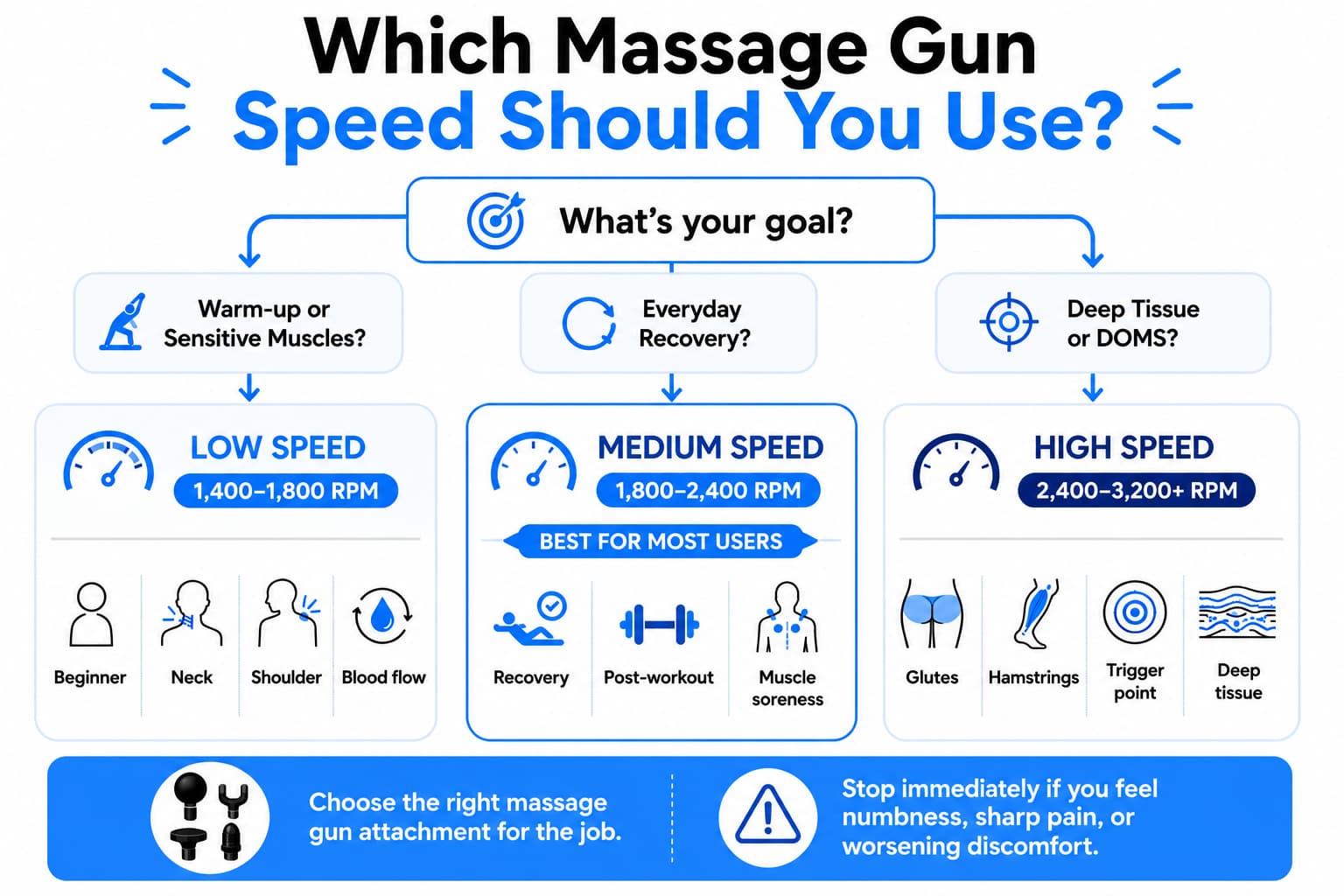
The best massage gun speed depends on your recovery goal and the muscle you’re treating. Lower speeds are ideal for gentle muscle activation, medium speeds work well for everyday recovery, and higher speeds are best for deep-tissue massages and stubborn knots.
Use the table below as a quick guide when choosing the right RPM setting.
| Goal | Recommended Speed |
| Warm-up | Low |
| Muscle activation | Low |
| Sensitive muscles | Low |
| Daily stiffness | Medium |
| Post-workout recovery | Medium |
| General recovery | Medium |
| Deep tissue massage | High |
| Trigger points | High |
| Severe delayed onset muscle soreness (DOMS) | High |
If you’re unsure which setting to use, start with a lower speed, then gradually increase until the massage feels comfortable and effective.
Common Mistakes When Choosing Massage Gun Speed
Using the wrong massage gun speed can make your treatment less effective or even uncomfortable. Avoid these common mistakes to get the best results.
- Starting at the highest speed: Begin with a lower setting and increase it gradually if needed.
- Thinking faster means stronger: A higher RPM doesn’t always provide a deeper or more effective massage.
- Using high speed on sore injuries: Stick to lower speeds around tender or sensitive muscles, and avoid using a massage gun on acute injuries unless advised by a healthcare professional.
- Holding the gun in one spot too long: Keep the massage gun moving and spend only 30–60 seconds on each muscle area.
- Ignoring discomfort: If you feel sharp pain, numbness, or increased soreness, reduce the speed or stop using the massage gun.
Choosing the right speed and listening to your body will help you recover safely and effectively.
Tips for Using Massage Gun Speed Safely
Using the right speed helps you get better results while reducing the risk of discomfort or injury. Follow these simple tips:
- Start low and increase the speed gradually as your muscles relax.
- Let the massage gun glide over the muscle instead of pressing down hard.
- Keep it moving and avoid staying in one spot for more than 30–60 seconds.
- Drink water afterwards to support your recovery.
- Stop immediately if you feel numbness, sharp pain, or worsening discomfort.
- Use high speeds sparingly on stubborn knots and large muscle groups.
- Choose the right attachment for the job. Different massage heads suit different muscles and recovery goals. Our article on how different massage gun attachments work has more details.
Choose the Right Massage Gun Speed for Better Recovery
The best massage gun speed is the one that matches your recovery goal, not simply the highest RPM.
Low speeds are ideal for warm-ups and sensitive muscles, medium speeds offer the best balance of comfort and effectiveness for everyday recovery, and high speeds work well for deep-tissue massage and stubborn knots.
Start with a lower setting and increase it only if needed.
If you’re still deciding which massage gun to buy, check out our guide to the best massage guns in Australia for expert reviews, feature comparisons, and top recommendations.
Related Questions
1. What massage gun speed should beginners use?
Beginners should start with a low-speed setting between 1,200 and 1,800 RPM. This provides gentle muscle stimulation and helps you get used to the massage without causing unnecessary discomfort.
2. What massage gun speed is best for recovery?
A medium speed setting between 1,800 and 2,400 RPM is the best choice for most post-workout recovery sessions. It helps relieve muscle soreness, improve circulation, and relax tight muscles without feeling too intense.
3. Can high massage gun speeds damage muscles?
High-speed settings are generally safe when used correctly, but they can cause discomfort if applied too aggressively or directly over bones and joints. Always keep the massage gun moving, use light pressure, and stop if you feel sharp pain or numbness.
4. How long should I use one speed setting?
Use the same speed setting for about 30 to 60 seconds per muscle group before moving to another area. Avoid staying in one spot for too long, as this can lead to irritation rather than effective muscle recovery.
- Why Does My Skin Itch After Using a Massage Gun? - 23 September 2026
- Adjustable vs Fixed Stride Ellipticals: Which Is Better? - 22 September 2026
- What Is Treadmill Deck Cushioning and Does It Really Protect Your Joints? - 21 September 2026