Most people should choose a vibration plate size of at least 60 cm × 40 cm, but there isn’t one “best” size for everyone. The right choice depends on your body size, workout style, available space, and long-term fitness goals.
Platform size affects more than storage. It also impacts your comfort, stability, exercise options, and safety during workouts.
In this guide, you’ll learn the recommended platform sizes, which size suits different users, and the key features to consider before buying.
- 💡 Quick Answer
- Why Vibration Plate Size Matters
- How to Choose the Right Vibration Plate Size
- What Size Vibration Plate Do You Need Based on Your Goals?
- Does Your Height Affect the Vibration Platform Size?
- Other Important Specifications Besides Vibration Plate Size
- How Much Space Do You Need Around a Vibration Plate?
- Common Mistakes When Choosing a Vibration Plate Size
- Final Verdict: Which Vibration Plate Size Should You Choose?
- Related Questions
Why Vibration Plate Size Matters
The size of a vibration plate affects more than how much floor space it takes up. It also plays a big role in how comfortable, safe, and effective your workouts are. Choosing the right platform size gives you enough room to move naturally and perform a wider range of exercises with confidence.
A larger platform offers several benefits, including:
- Better stability: A wider stance improves your balance and reduces the risk of stepping off the platform.
- More exercise options: You’ll have enough space for squats, lunges, push-ups, planks, stretching, and resistance band workouts.
- Greater comfort: Your feet can sit in a more natural position, and taller users have extra room to move.
- Improved safety: A larger platform provides better support during dynamic movements and makes it easier to progress to more challenging exercises over time.
Choosing the right size helps you get more from every workout while reducing the risk of injury.
How to Choose the Right Vibration Plate Size
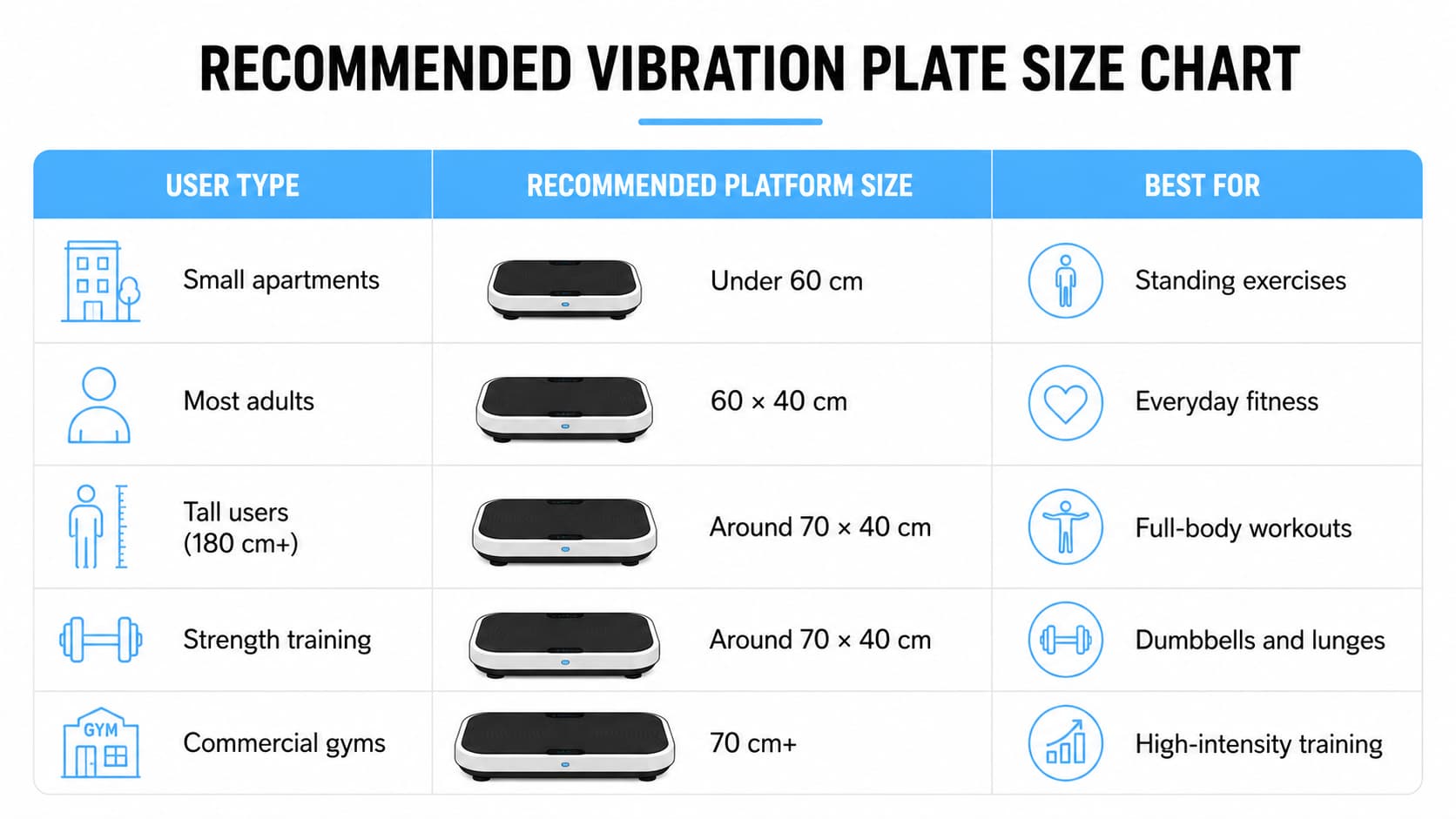
The best vibration plate size depends on how you’ll use it and how much space you have at home. Here’s a size guide you can refer to.
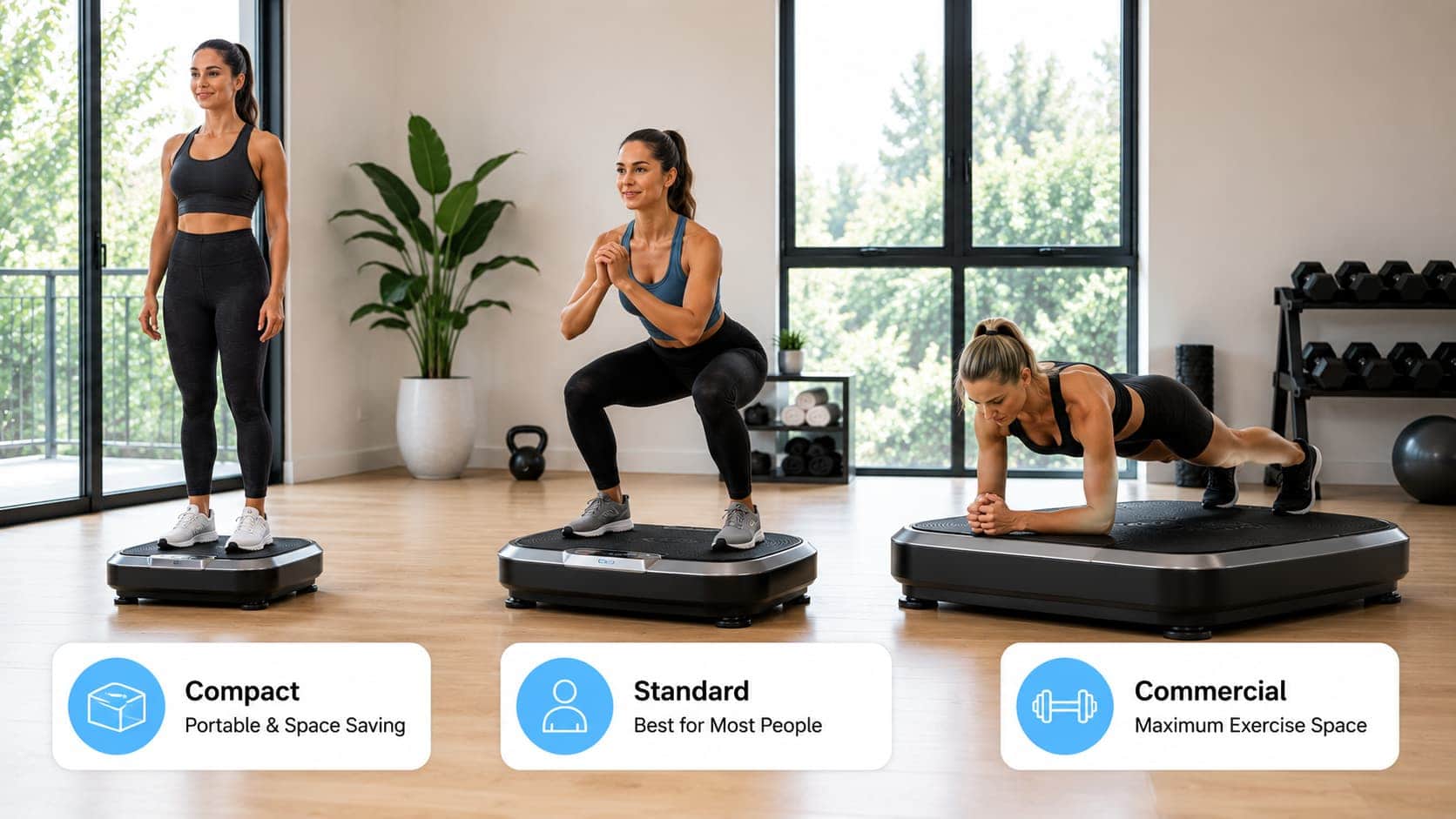
1. Compact/Mini Plates (Under 60 cm Wide)
Compact vibration plates are ideal for apartments, small homes, travel, seniors, and anyone who mainly wants to perform standing or seated exercises with minimal storage space. If you’re buying a vibration plate for an older adult, our article on the benefits of vibration machine exercises for the elderly has more helpful info.
- Pros: Lightweight, affordable, portable, and easy to store.
- Cons: Small foot platform, lower weight capacity, and limited room for squats or wide stances.
2. Standard Home Plates (60–70 cm Wide)
Standard-sized vibration plates are the best choice for most Australians because they provide enough room for a wide range of exercises without taking up excessive space.
They’re ideal for weight loss, general fitness, muscle toning, and balance training, making them a great all-round option for home use.
- Pros: Comfortable stance, supports squats and lunges, suitable for dumbbell workouts, higher weight limits, and excellent long-term versatility.
- Cons: Heavier and requires a dedicated workout area.
3. Extra-Large/Commercial Plates (70 cm+ Wide)
These larger platforms are best suited to taller users, athletes, functional fitness enthusiasts, and anyone building an advanced home gym who wants maximum workout space.
- Pros: Maximum stability, high weight capacity, and plenty of room for push-ups, planks, and dynamic exercises. Want to get the most from a larger platform? Try these full-body vibration machine exercises to see how the extra workout space makes movements like planks, push-ups, and strength exercises more comfortable.
- Cons: More expensive, heavy (often 45 kg or more), difficult to move, and requires plenty of floor space.
What Size Vibration Plate Do You Need Based on Your Goals?
Your fitness goals have a bigger impact on the ideal vibration plate size than your body weight alone. Think about the exercises you want to do now and how your workouts may change in the future.
- Weight loss: A standard 60–70 cm platform gives you enough room for cardio-style movements and full-body workouts.
- Muscle building: Choose a larger platform if you plan to use dumbbells or perform squats and lunges.
- Balance & rehabilitation: A stable platform provides better support and confidence during controlled movements.
- Seniors: A larger platform offers extra foot space, making it easier to maintain balance.
- Home gyms: Standard-sized models provide the best mix of versatility, comfort, and space efficiency for most homes.
Does Your Height Affect the Vibration Platform Size?
Yes. Your height can influence the vibration plate size that’s most comfortable to use. Taller people generally have a longer stride and naturally stand with their feet farther apart, so they often benefit from a larger platform.
| Height | Recommended Size |
| Under 165 cm | Compact or Standard |
| 165–180 cm | Standard |
| Over 180 cm | Around 70 × 40 cm |
A larger platform gives taller users more room for squats, lunges, and other full-body exercises while improving stability. If you’re shorter, a standard-sized platform will still provide plenty of space for comfortable and safe workouts.
Other Important Specifications Besides Vibration Plate Size
Platform size is important, but it shouldn’t be your only consideration. The best vibration plate combines the right dimensions with features that match your fitness goals and experience level.
- Movement type: Oscillating (pivotal) plates use a side-to-side see-saw motion that’s ideal for circulation, muscle activation, balance, and everyday fitness. Linear (vertical) plates move straight up and down, creating a higher-intensity workout that’s often preferred for strength training.
- Frequency range: Lower frequencies suit recovery, moderate frequencies are great for general fitness, and higher frequencies are better for strength and athletic training. Our guide on how to choose the right vibration plate frequency settings has more details.
- Amplitude: This is how far the platform moves. Look for an adjustable range of 2–10 mm, as amplitude works with frequency to control workout intensity.
- Weight capacity: Choose a machine rated at least 20 kg above your body weight, with extra capacity if you’ll use dumbbells.
- Motor power: Focus on continuous motor power rather than peak wattage, and choose a motor that suits how often and how intensely you’ll train.
How Much Space Do You Need Around a Vibration Plate?
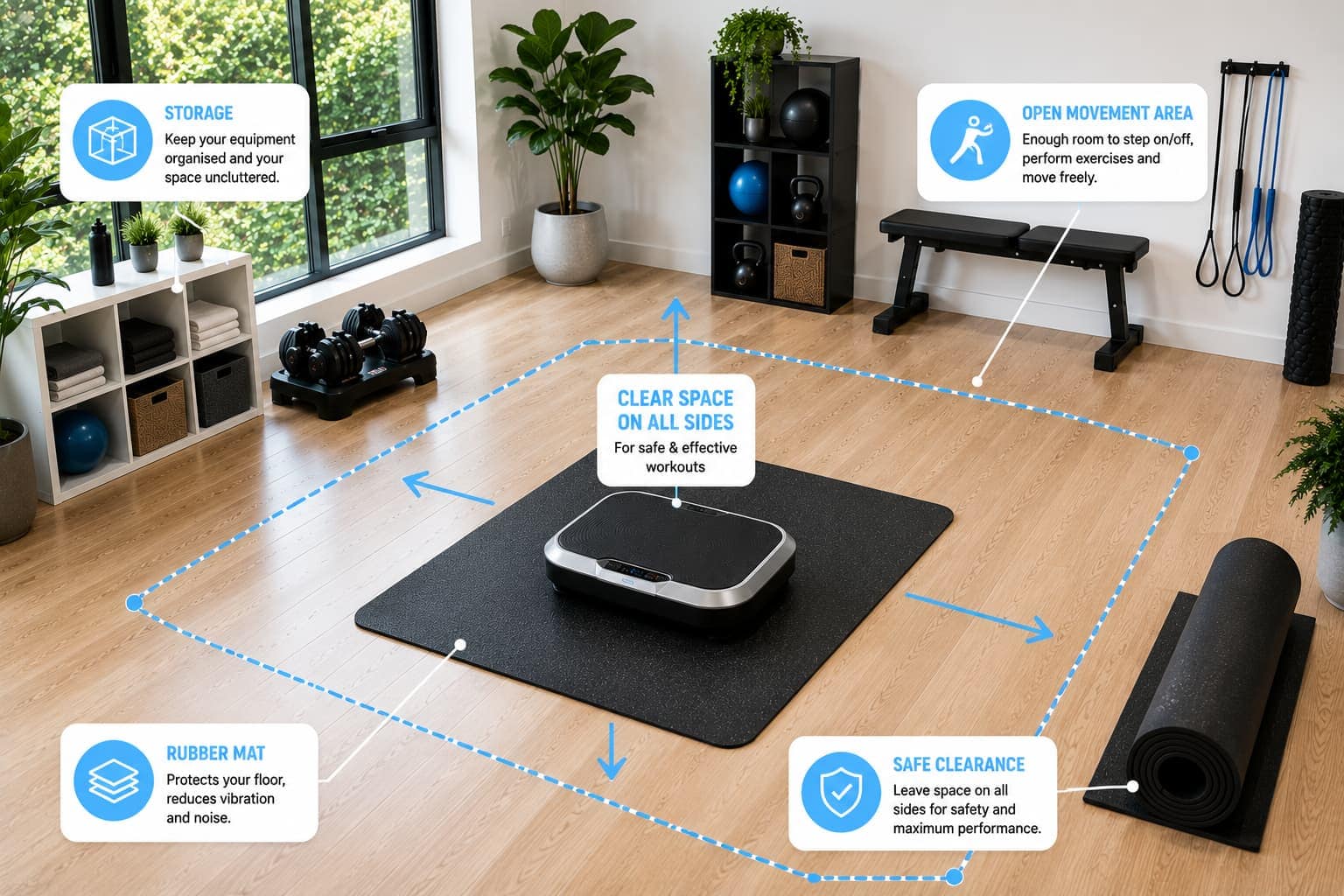
Before buying a vibration plate, make sure you have enough room to use it safely and comfortably. Besides the machine’s footprint, consider the surrounding space:
- Floor clearance: Leave enough room on all sides so you can step on and off safely and perform exercises like lunges.
- Storage: Compact models can slide under a bed or couch, while larger machines usually need a permanent spot.
- Ceiling height: Ensure there’s plenty of headroom if you’ll be standing upright.
- Rubber mats: Place the machine on a rubber mat to reduce noise and protect your flooring.
- Dedicated workout area: Apartments suit compact models, while home gyms can easily accommodate larger platforms.
Common Mistakes When Choosing a Vibration Plate Size
Choosing the wrong vibration plate size can leave you with a machine that doesn’t suit your needs. Avoid these common mistakes before you buy:
- Buying the smallest model just to save money, even if it limits your workouts.
- Ignoring your future fitness goals, such as adding strength training or balance exercises.
- Forgetting to check the machine’s weight capacity, especially if you’ll use dumbbells.
- Choosing a commercial-sized platform when a standard model is enough.
- Not measuring your available storage or workout space.
- Assuming a larger platform always provides a better workout, regardless of how you plan to use it.
Final Verdict: Which Vibration Plate Size Should You Choose?
Choosing the right vibration plate size comes down to how you plan to use it.
If you want a portable machine for light workouts or travel, a platform under 60 cm is a good choice. For most Australian homes, a 60–70 cm platform offers the best mix of comfort, exercise variety, and value. If you’re tall, an athlete, or want extra room for advanced exercises, choose a platform 70 cm or larger.
Still deciding which model is right for you? Read our reviews onvibration platform machines in Australia to compare sizes, features, and overall value before making your purchase.
Related Questions
1. Is a larger vibration plate always better?
No. A larger vibration plate provides more room for exercises like squats, lunges, and planks, but it also takes up more space and costs more. Choose a size that matches your workout style, available space, and fitness goals.
2. Can I lose weight on a compact vibration plate?
Yes. A compact vibration plate can support weight loss when combined with regular exercise and a healthy diet. However, its smaller platform may limit the variety of exercises you can perform compared to a standard-sized model.
3. Does platform size affect vibration intensity?
No. Platform size doesn’t determine vibration intensity. Intensity is mainly controlled by the machine’s frequency, amplitude, and movement type, while platform size affects your comfort, stability, and exercise options.
- Front-Drive vs Rear-Drive Ellipticals: Which Is Better for Your Home? - 23 October 2026
- What Treadmill Weight Capacity Do You Need? Why Weight Limits Matter - 22 October 2026
- Can You Leave an Exercise Bike Outside? - 21 October 2026