Length matters more for runners because it accommodates a longer stride, while treadmill belt width becomes increasingly important for stability, balance, and larger users.
Both treadmill belt length and width affect your comfort, safety, and workout performance, but they play different roles.
The best choice depends on your height, whether you walk, jog, or run, and how intensely you plan to exercise. Understanding these differences can help you avoid buying a treadmill that feels too cramped or uncomfortable.
In this guide, you’ll learn how belt width and length compare so you can confidently choose a treadmill that’s better suited to your needs and fitness goals.
- 💡 Quick Answer
- What Does Treadmill Belt Length Affect?
- What Does Treadmill Belt Width Affect?
- Treadmill Belt Width vs Length Comparison
- Recommended Treadmill Belt Sizes by Activity and Height
- Recommended Treadmill Belt Sizes for Different Types of Users
- Common Mistakes When Choosing Treadmill Belt Dimensions
- Other Treadmill Features That Also Matter
- Choose the Right Treadmill Belt Dimensions for Your Needs
- Related Questions
What Does Treadmill Belt Length Affect?
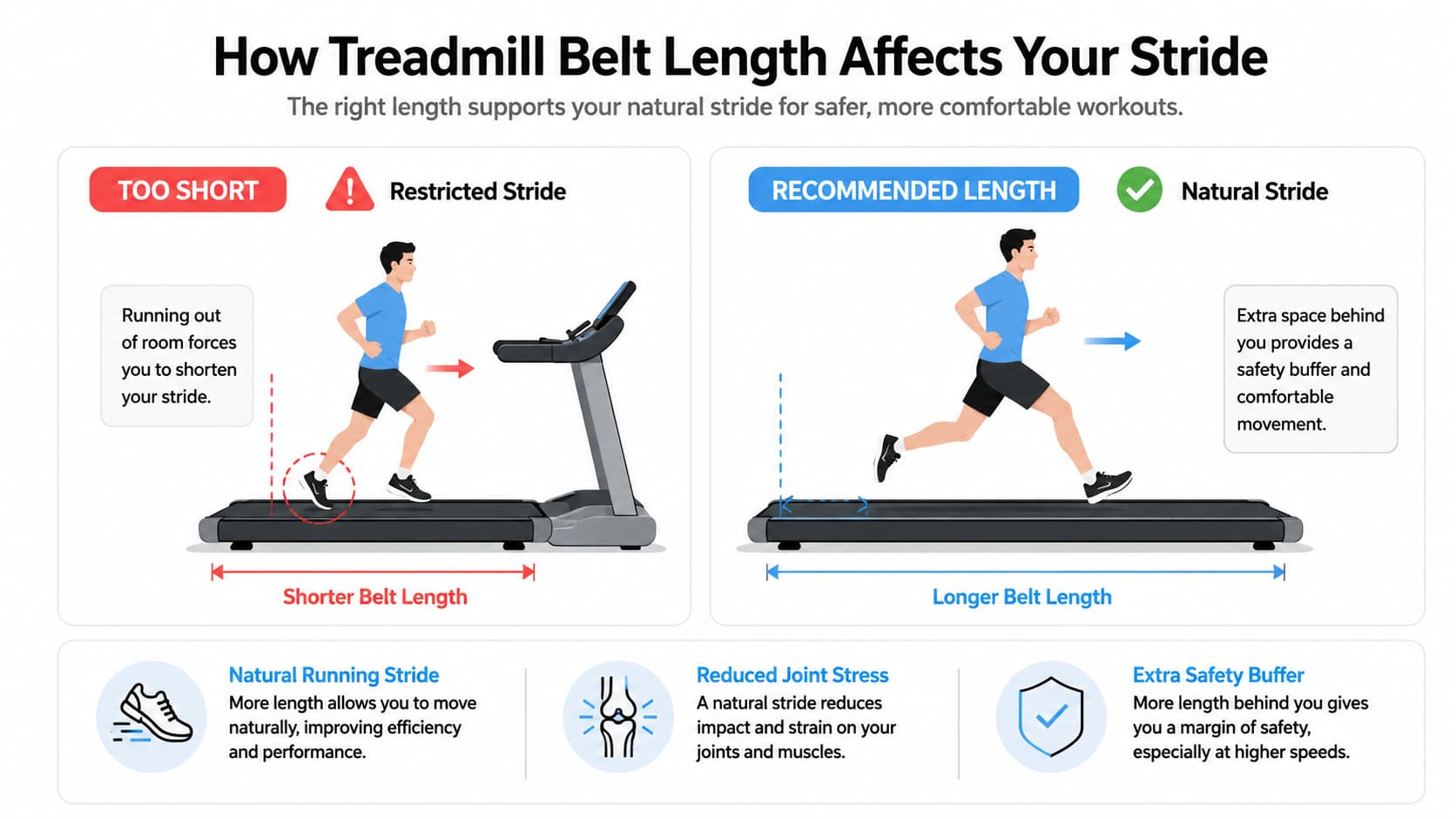
Treadmill belt length determines how much room you have to move with your natural stride.
This is especially important if you jog or run, as your steps become much longer at higher speeds. Choosing a belt that’s too short can make your workouts feel awkward and less comfortable.
Here’s why belt length matters:
- Supports your natural running stride: Running increases your stride length. A short deck forces you to shorten your stride, which can place extra stress on your knees, hips, and ankles.
- Improves safety: A longer belt provides a valuable “buffer zone,” making it less likely you’ll drift off the back of the treadmill. For most runners, a deck that’s 150 cm (60 inches) or longer is recommended.
- Increases comfort at higher speeds: A longer running surface lets you speed up naturally without constantly having to stay centred on the belt.
If you’re unsure what size is right for you, read our guide on treadmill belt size for more detailed recommendations.
What Does Treadmill Belt Width Affect?
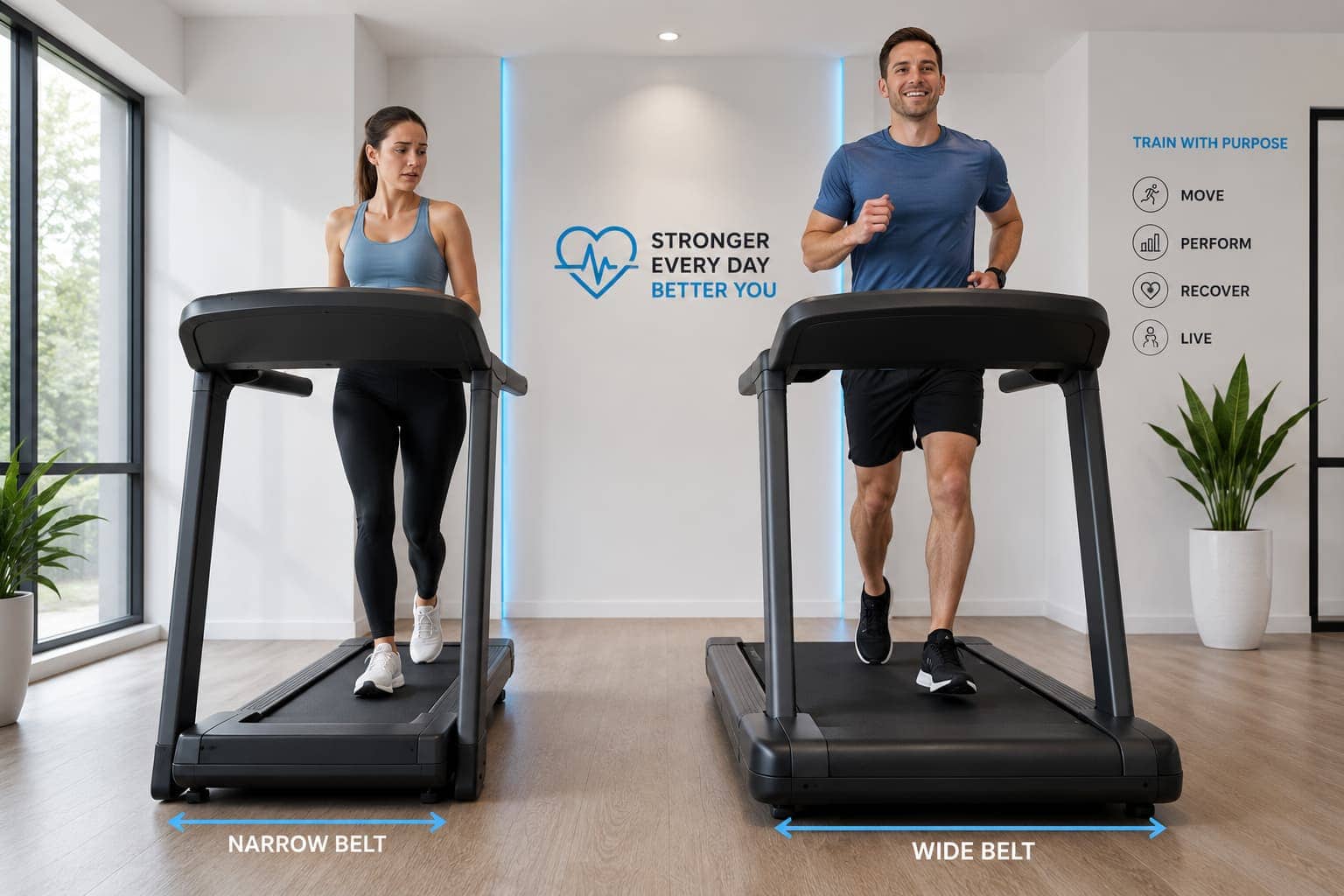
Unlike belt length, treadmill belt width doesn’t affect your stride. Instead, it plays a significant role in your comfort, stability, and confidence during exercise.
A wider belt gives you more space to move naturally, helping you feel safer and more relaxed during your workout.
Here’s how belt width makes a difference:
- Improves stability: A wider belt provides more room for natural movement and reduces the chance of accidentally stepping on the side rails.
- Supports your natural gait: Everyone moves slightly from side to side when walking or running. Wider belts better accommodate this natural motion.
- Fits larger body frames: Users with broader shoulders or hips often feel more comfortable in 50–55 cm wide belts.
- Builds confidence for beginners: Wider decks feel less restrictive, making them a great choice for seniors and first-time treadmill users.
If you’re using a treadmill mainly for walking, check out our guide on how to walk 10,000 steps a day using a treadmill for practical tips and motivation.
Treadmill Belt Width vs Length Comparison
Both treadmill belt width and length contribute to a safe and comfortable workout, but they affect your experience in different ways. Belt length is more important for supporting your stride, while belt width provides extra stability and confidence.
The table below highlights the key differences.
| Feature | Belt Width | Belt Length |
| Affects stride | Minimal | High |
| Affects stability | High | Moderate |
| Important for runners | Medium | Very High |
| Important for walkers | High | Moderate |
| Important for tall users | Medium | Very High |
| Safety | Moderate | Very High |
| Comfort | High | High |
For the best experience, choose a treadmill with enough length for your stride and enough width to help you feel stable and comfortable throughout every workout.
Recommended Treadmill Belt Sizes by Activity and Height
The right treadmill belt size depends on how you plan to use it and your height. The dimensions below are recommended minimums for a safe and comfortable workout.
If your budget and space allow, choosing a slightly larger belt can make your exercise sessions feel more natural and enjoyable.
| User | Minimum Width | Minimum Length |
| Walking only | 40 cm (16”) | 120 cm (47”) |
| Jogging / Average Height | 46 cm (18”) | 135 cm (53”) |
| Running / Taller Users (Over 182 cm / 6’0”) | 50 cm (20”) | 150 cm (60”) |
Keep in mind that these are starting points. A wider or longer belt can improve comfort, especially if you have a longer stride, a larger frame, or enjoy running at higher speeds.
Recommended Treadmill Belt Sizes for Different Types of Users
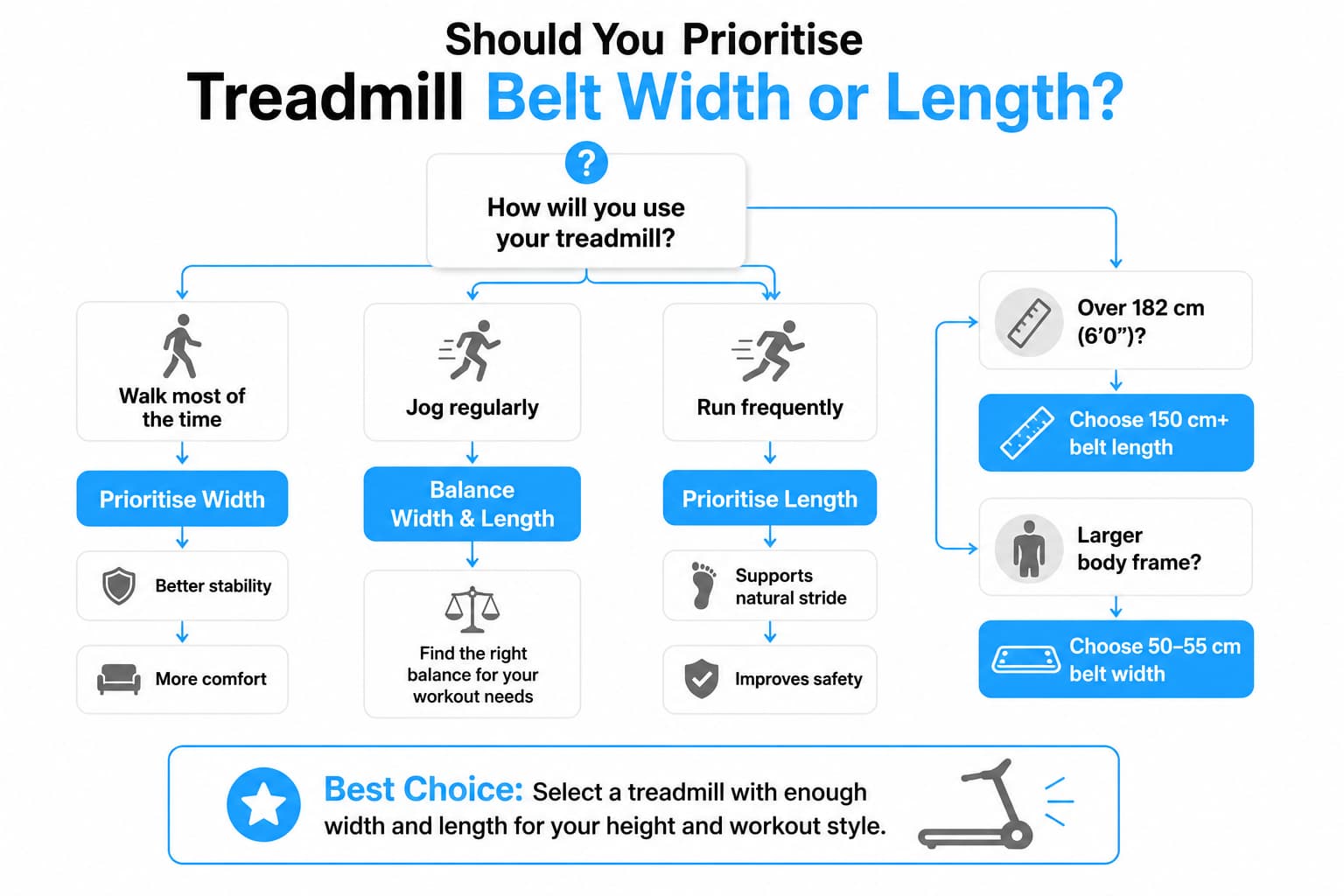
The best treadmill belt size depends on your body type and how you exercise. Here’s what to prioritise for different users:
- Walkers: Belt width is often more important than length because it provides extra comfort and stability. A shorter belt is usually enough for a walking stride.
- Joggers: Choose a treadmill with a good balance of width and length. Jogging increases your stride, but not as much as running.
- Runners: Length should be your top priority to support a natural stride. A wider belt also helps you feel more confident at faster speeds.
- Tall users: A longer running deck is essential to accommodate a naturally longer stride. Width is still beneficial but usually less important.
- Larger-framed users: A wider belt improves stability and comfort. Also, if you run, choose a longer deck.
- Seniors: Wider treadmill belts provide extra confidence, improve balance, and reduce the feeling of instability during walking workouts.
If you’re ready to buy a treadmill, check out our guide to the best treadmills under $1,000 in Australia to compare affordable models with belt sizes suited to different users and workout styles.
Common Mistakes When Choosing Treadmill Belt Dimensions
Choosing the wrong treadmill belt size can make your workouts less comfortable and even increase your risk of injury. Avoid these common mistakes when comparing models:
- Choosing based only on price instead of comfort and fit.
- Buying the shortest running deck available when you plan to jog or run.
- Ignoring your height, especially if you’re tall and have a longer stride.
- Ignoring workout intensity, as running requires more belt length than walking.
- Assuming all treadmills have similar belt dimensions.
- Confusing deck size with the overall treadmill size.
- Not considering who else will use the treadmill if it’s shared by family members.
- Overlooking belt width, which can affect balance and confidence, especially for beginners and larger users.
Other Treadmill Features That Also Matter
Belt width and length are important, but they’re only part of choosing the right treadmill. You’ll also want to look at other features that affect performance, comfort, and durability.
When comparing treadmills, consider:
- Motor power for smooth and reliable performance.
- Weight limit or capacity to ensure the treadmill safely supports the user.
- Cushioning and shock absorption to reduce impact on your joints.
- Incline capability for more challenging and varied workouts.
- Stability to minimise wobbling during exercise.
- Deck construction for long-lasting durability and comfort.
Choose the Right Treadmill Belt Dimensions for Your Needs
There is no one treadmill belt dimension that’s better for everyone. The right choice depends on your height, body size, and how you plan to exercise.
If you run, are taller, or enjoy high-speed workouts, belt length should be your priority. If you mainly walk, want better stability, or have a larger frame, belt width is just as important. For the most comfortable and safest workout, choose a treadmill with enough width and length to suit your needs.
Ready to compare top-rated models? Read our guide to the best treadmills to buy in Australia and find the right fit for your home gym.
Related Questions
1. Is treadmill belt length more important than width?
Yes, if you plan to run regularly. A longer belt allows your natural running stride and reduces the risk of stepping off the back. For walking, width often has a greater impact on comfort and stability.
2. What is the best treadmill belt width?
The best treadmill belt width depends on how you plan to use your treadmill. For walking, a belt that is at least 40 cm (16 inches) wide is generally sufficient. If you jog, a 46 cm (18-inch) belt offers a better balance of comfort and stability. For running, a belt that is 50 cm (20 inches) or wider is recommended, as it provides more room for natural movement and helps you feel more confident at higher speeds.
3. Do taller people need longer treadmill belts?
Yes. Taller users naturally have longer strides and typically benefit from belts that are at least 150 cm (60”) long.

- Front-Drive vs Rear-Drive Ellipticals: Which Is Better for Your Home? - 23 October 2026
- What Treadmill Weight Capacity Do You Need? Why Weight Limits Matter - 22 October 2026
- Can You Leave an Exercise Bike Outside? - 21 October 2026